
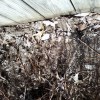

While I was actively working in a client’s flower bed, getting rid of the Canadian thistle a few years ago, I noticed these little black dots all over her garden walls.
These dots were by her front door, on the hard surfaces of concrete blocks that formed a border for her beds.
The south-facing wall had a fairly moist, protected micro-climate as the backdrop for the bed.
This warm and moist condition is ideal for growing mushrooms, creating a potential mushroom problem.
While I was there, the little dots did not move. I put these dots under my field microscope, and I couldn’t see anything that would indicate that they were an insect or other arthropod. No wings, legs, antenna, or body segments!
These tiny dots were fired at this surface, creating oval dots on the walls. Each of these little dots was egg-shaped once they landed on the surface. It was very hard to see anything else around the little dots. A hardwood mulch bed was adjacent to the wall.
The proximity of the mulch, beside the wall, allowed the source of the little dots to remain concealed.
Flinging fungi are most commonly found in hardwood mulch
Saprophytes such as cannonball fungus feed only on dead plant material, not harming any live plants.
Cannonball fungus is most frequently encountered in hardwood mulch but can also colonize decaying wood and, less commonly, animal dung. The species requires both moisture and sunlight for optimal development.
Growth and sporulation are particularly vigorous when ambient temperatures range from 50°F to 70°F (10°C to 21°C), typically during spring and fall. Notably, once temperatures reach approximately 78°F (25.5°C), the fungus actively discharges its peridioles, facilitating efficient spore dispersal.
If my crew and I had been lucky enough to have seen the source of the cannonballs, we may have seen the process of this powerful sphere-throwing fungus propelling these black and red spheres a great distance in comparison to the size of the source. The mechanism of spore discharge in Sphaerobolus stellatus is a subject of scientific interest.
The fungus produces peridioles that are forcibly ejected via a rapid inversion of the peridium’s membrane, a process driven by turgor pressure and changes in internal osmotic balance. Glycogen conversion to sugars within the fungal cells increases fluid retention.
The turgor pressure build up changes the internal osmotic balance. The resulting buildup of pressure that ultimately propels the peridiole away from the fruiting body. This unique adaptation optimizes spore distribution and enhances colonization of new substrates.
Finally, this little membrane finishes turning itself inside out, leaving a star-shaped, empty protective covering. You can see what looks like little peppercorns all over a hard surface as a result.
Sphaerobolus stellatus, or Cannonball fungus, as it lands on nearby plants, could be spread by herbivores grazing and eliminating the spores from their systems.
What do to do if you discover cannonball fungi
This tiny fungus is there only to help break down the wood in the wood chips. If you have no wood chips, you would have no fungus. Of course, as you add chips to the mulch bed, you are adding to the food source for this fungus.
With favorable, moist conditions in the mulch, the fungus has a great chance to grow and spread. Dog vomit slime mold or (Fuligo septica), and other stinkhorn or (Phallacae) fungi, as well as Cannonball fungi all exhibit similar spore discharge mechanisms.
These fungi are very difficult to eradicate unless you completely replace the mulch where you discovered the initial fungus. Saprophytic fungi such as Dog vomit, Cannon Ball, and Stinkhorn fungi are limited in their scope of diets.
Here is the key. If you are patient with the situation, the fungus will, in time, run out of the nutrients it needs to survive, thus starving itself out. One thing I do know is that if you add pine bark or cypress mulch, you are changing the soil chemistry, making the atmosphere of the Cannonball fungus more difficult to survive in.
A heavy layer of newsprint, at least two inches thick over the surface of the mulch where the black dots are appearing, may solve the problem. There are several solutions to this challenge.
By removing the hardwood mulch as a food source and replacing it with another mulch, you will eliminate this fungus entirely.
I hope you have a nice stroll through your garden this week. It does feel like spring has arrived. Thank you for reading my column for the past 17 years. If you see any issues out there, don’t hesitate to drop me an email.
I shall do my best to answer your questions. My e-mail address is ericlarson546@yahoo.com.