
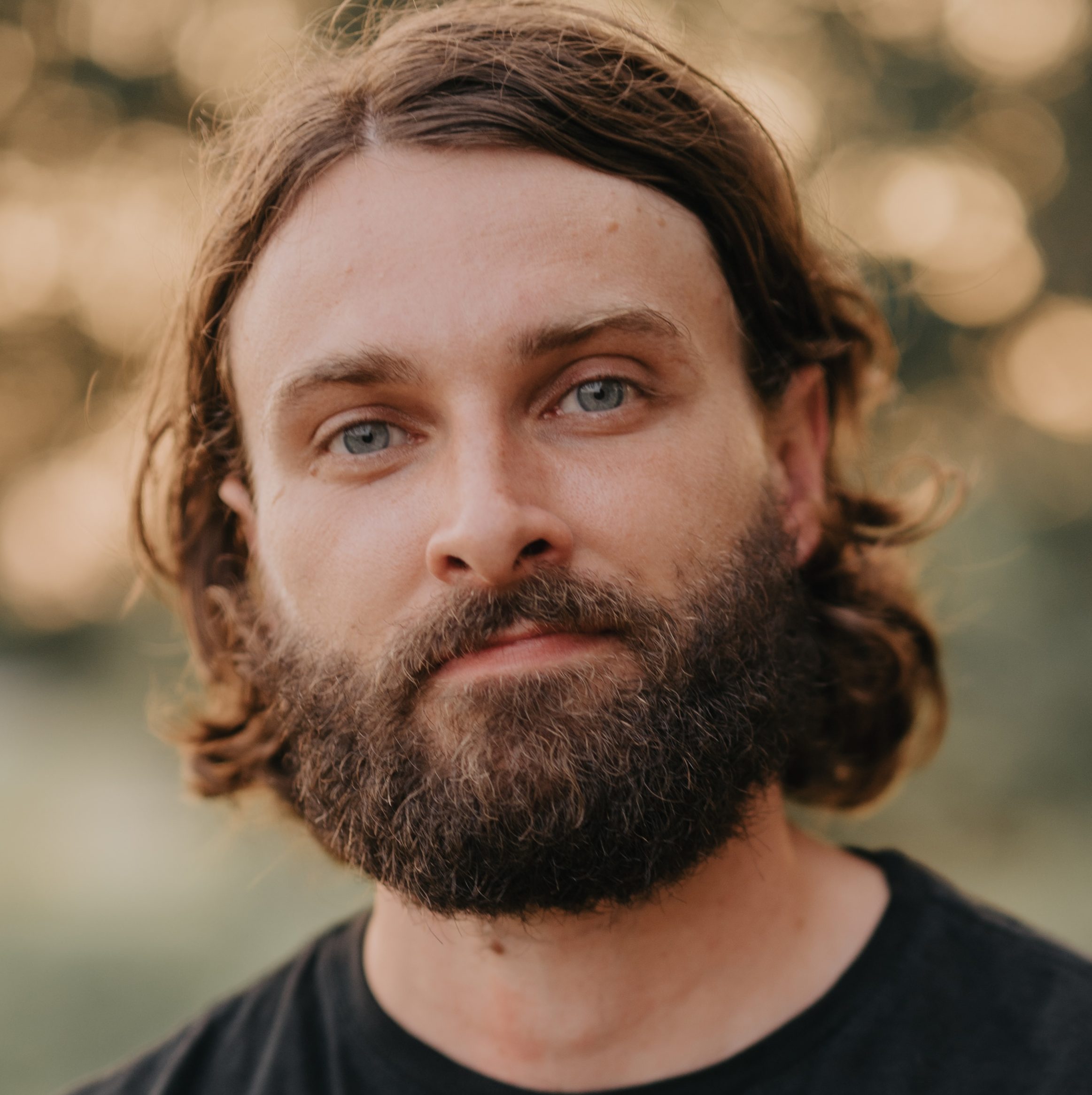

Ben Bowman is a hugger. Not a casual one, an enthusiastic one; he’s the type of hugger who counts how many he gets in one day. One might argue he has a problem, that he’s addicted to it or even weird about it. The shoulder tap normal beings give to those we embrace, the one that universally signifies the conclusion of this particular physical contact, doesn’t work for Ben. In fact, he often ignores the shoulder tap. If you ask him, he’ll tell you it’s just who he is. In other words, he fully embraces his huggy-ness.
Ben is also one of Ohio’s more than 73,000 heavy truck drivers. He has driven heavy trucks carrying various items of commerce across state lines for 11 years. The profession runs deep in his family. He was named after his great uncle who worked for Norfolk and Western back when trains were today’s truck. His father was a trucker, too.
Ben, 36, doesn’t look like a trucker (if there’s a certain rough-and-gruff aesthetic). He has a friendly face and his prescription aviator-style glasses make his eyes appear tiny. He stands at a round 5 feet 6 inches. His voice has a meek rasp, and it is also laced with passion, often resembling the whisper someone makes when feigning a cheering crowd.
Ben is also a man of faith. He wasn’t always that way, but now that he is, he feels as if he has a lifetime of ungodliness to correct. This often manifests in an eagerness to, say, hug someone or to pray with someone for more than is typically socially acceptable. His approachable outward appearance, though, means this is rarely challenged.
And so you might ask if Ben is in the wrong industry. The job pays the bills (he said he makes around $50,000 a year, which according to the Bureau of Labor Statistics, is a bit higher than the average for heavy truck drivers in Ohio and nationally). But like all truckers, he sits on his bucket seat moving 60 mph over the highway for long stretches of time without being around a single soul. So who would he get to hug? Who would he pray for?
I spent around 90 hours with Ben from March 3 to 7. Ben decided weeks prior he would make the trek from Ashland, where he lives, to the Washington, D.C. area to be part of the People’s Convoy, a group of truck drivers who vowed to stand against COVID-19 restrictions and mandates.
Curious why he’d decide to do this — given the fact pandemic-related restrictions had been dropping like flies across the country since late February — I tagged along.
The People’s Convoy was inspired by the Freedom Convoy that originated in Canada in early 2022. That convoy’s objective was to end COVID-19 mandates for truckers who crossed the U.S. border but morphed into protesting general coronavirus-related restrictions.
The mission of the People’s Convoy was to make its presence known in the nation’s capital to “end the (national emergency) that led to overreaching mandates.”
From Ben’s and the thousands of truckers’ and supporters’ perspective, the pandemic-related restrictions would disappear at the end of this and freedom would ring for the American people once again. And truckers like Ben would stand proud as the fearless victors. Forever they would wear the victory as a pin on their trucker hats because, like so many before them, they stuck it to the Man.
Ben is angry. He’s angry over what he perceives as “government overreach,” which can be translated to the stripping of American liberties by the government’s effort to curb the spread of COVID-19. Like many people, he’s fed up.
He’s also scared. Scared that if he and his fellow members of the People’s Convoy don’t stand up to this overreach what that will mean for future generations of truckers and Americans and, really, everyone who calls Earth home.
He spends a lot of time talking about this on the trip, explaining his side of the story. And versions of this sentiment are expressed through other participants of the People’s Convoy, like Mike Moore.
Moore, of New London in Ashland County, is 45 and drives for Jake’s Hauling in Mansfield.

“I’ve been a trucker for 20 years,” he said, pulling a string overhead that releases an ear-piercing train horn. He laughs as a chorus of honking fills the air at the Hagerstown Speedway, a race car course about an hour northwest of Washington, D.C. Honking is a regular occurrence at the speedway, a way to build camaraderie and keep the excitement of the movement alive.
For Moore, the People’s Convoy is about fighting for the redistribution of power back to the people. He was away from home for about four days by the time he reached Hagerstown with hundreds of other truckers awaiting a trip to the D.C. Beltway to demonstrate their disapproval of public health restrictions.
Moore said he would head back to Ohio in order to start work on Monday, March 7, making his stay about five days — his family needed him to continue working for a paycheck.
Lighting a cigarette, he gets emotional when discussing his 13 year-old daughter, who likened what he was doing to a single decision a woman made back in the 1950s and that led to the Civil Rights Movement.
“She doesn’t really get why I’m doing this,” he said, tears welling in his squinty eyes, exhaling a stream of smoke into the warm March air. “But before I left she asked me if it was sorta like what Rosa Parks did on the bus. I told her, ‘yes. It’s like that. We’re sitting at the front of the bus, baby.’”
The Canadian convoy’s main thrust was fighting a COVID-19 vaccine mandate for truckers crossing U.S. and Canada borders. The private sector in the U.S. faced a vaccine requirement through President Biden’s “Plan out of the Pandemic,” announced Sept. 9. The mandate, which affected 84 million people, was later blocked by the Supreme Court.
However, federal contractors and employees, workers at health facilities that receive Medicare and Medicaid funding and several state and local workers face vaccine mandates or weekly testing for the coronavirus, according to a chart published by Littler, a law firm.
Several states filed for injunctions on the federal vaccine requirements, which have effectively delayed the mandates’ deadlines.
Many people of the People’s Convoy support Conservative and Republican political ideals — including one of the convoy’s leaders — said the demonstration was not about politics. It was about coming together on the shared belief that the government shouldn’t dictate medical decisions, colloquially referred to as “medical freedom.”
Brian Brase, of Ohio, is one of the organizers of the People’s Convoy. One evening, in front of a cheering crowd, he said: “Those of us that are here that lean to the left and those that are here that lean to the right — and those that are independents, those who don’t affiliate with any political party — it takes the American people to stand together to get this stuff done and together we can.”
Ben didn’t face any so-called “jab or job” decisions with Dart Express, the trucking company he works for. Ben said the company’s policy regarding the COVID-19 vaccine is one of personal choice, leaving it up to drivers to get the shot or not. Still, the company, based in St. Paul, Minnesota, didn’t exactly support the People’s Convoy, or at least Ben’s part in it. His boss did not allow him to drive the company truck when he asked to drive it to D.C.
Dart Express declined to comment.
Instead, Ben took out a leave of absence from March 3 through April 3, missing five paychecks. He dipped into his personal savings to finance the trip, around $800 all said, and drove his personal Honda Pilot, which he packed full of snacks, plastic water bottles, lawn chairs and a PA system with a microphone.
He slept in the Pilot most nights, tilting the leather seat back to get sleep. (One night in Arlington, Virginia, he booked a room at a budget hotel.)
Ben supported Donald Trump in 2016 and 2020. In many ways, the people of the People’s Convoy are his people, supporting many ideas he’s adopted over the years.
“The government, over the past couple years, they pushed the limits on what they can get away with before getting any pushback from the people,” Ben said.
This, the People’s Convoy, was the people’s “long overdue pushback,” he added.
In many other ways, the people of the People’s Convoy were not his people. For instance, the frequent chanting “Let’s Go Brandon” and prevalence of “F*ck Biden” flags.
“I don’t like that. It’s not really necessary and it makes us all look a certain way. It gives people who are critical of us just more ammunition to paint us all as crazy conspiracy theorists,” he said.
So who is Ben Bowman? How does he fit into the People’s Convoy? Why did he take this trip that some people back home criticized as “a waste of time?”
Ben sits at an Italian take-out shop in Arlington, Virginia on the fourth day of his People’s Convoy trek. He dips his Philly Cheese Steak sub in barbecue sauce as he explains where much of his anger stems.
Ben was 10 when his parents split after a 12-year marriage. Some time after, his mom pulled him out of public school because he’d already failed the sixth grade and was on track to fail again. He was also bullied a lot and he was having behavioral issues. Her plan was to homeschool.
“She didn’t,” he said.
His mother died in 2019. His father declined to comment for this story.
Laura Lund, his aunt who lives in Hudson, helped Ben’s mother look after him and his siblings during those early years.
“He’s my nephew, my sister’s son. She was having a hard time in her life, and she just really couldn’t take care of her kids. My kids are younger than hers, so I was helping how I could, but I couldn’t do enough,” she said.
So from age 12 to 18, Ben didn’t go to school — formal school, that is. He was placed in a number of different foster and child care protective services. Some of them included “schooling,” he said, making air quotes with his fingers.
The lack of consistency at an early age led to anger issues, Ben said. Looking back, he wondered why he, with two living parents, needed to be placed in so many out-of-the-home programs.
“I think it was just to give my mom a break from me. She needed a break from me, she just couldn’t deal with it. I don’t blame her, I wouldn’t have wanted to put up with me either,” he said.
It became a game to him to see how soon he could get a new case manager. He wanted to throw them off. It was his way of lashing out.
Eventually, at 15, the lashing out landed him at Parmadale Residential Treatment Center in Parma. He stayed there for a total of 28 months during two separate stays in the early 2000s. The facility has been in the news several times over the last two decades for its alleged sexual and physical abuse to children.
Ben said he never experienced sexual abuse. “But there was physical abuse,” he said, adding it only ever came from the other troubled kids also staying at the center.
By the time he got out of Parmadale, at age 18, Ben had experienced some things that would lead to what he said was Post Traumatic Stress Disorder. He was never formally diagnosed with the condition. He was, however, diagnosed with an anxiety disorder years after staying at Parmadale, yet doctors at the time told him the disorder was unrelated to his time at the treatment facility.
Ben is adamant he suffered from PTSD as a result from the bullying, punching and hitting he endured during his time at Parmadale. The kids, he said, would wait until staff members weren’t looking.
Still, something good came out of the residential treatment center, said his aunt, Laura.
An employee at Parmadale got through to him. The woman does not work there anymore.
“She connected with him somehow. He was able to see his life ahead and what it could look like if he got things in order,” Ben’s aunt said.
Ben said it was the woman’s kindness. On her last day at Parmadale after recently quitting, she and Ben shared a moment before she left.
“She told me I would do great things,” he said, fighting tears. “And that she has faith in me … she lifted me up.”
Efforts to reach the former employee, who now lives in a different state, failed.
Soon after his discharge at Parmadale, he set a goal of obtaining his GED. He did so in 2004, at the age of 19. Soon after that, he earned his driver’s license. “I was lucky enough to pass my test after the first attempt,” he said.
Lund said she’s proud of him. “He had some hard times to get through,” she said.
Another goal he set around that time was getting a library card, which Ben did. One day he drove his bicycle — it would be another year before buying his first vehicle — to the Akron-Summit County Public Library and browsed through the nonfiction section. It was there he found a book written by Donald Trump. He doesn’t remember which one he read first, but it didn’t take long for him to finish it and a few others written by the New York business mogul, who at the time also happened to be the star of NBC’s relatively new primetime reality television series The Apprentice.
Ben tore through the books.
He didn’t exactly care about Trump’s political stances or aspirations at the time, he said. But Trump’s story, as told through a number of his books, inspired Ben.
“Just him talking about his childhood, his father, his struggles in life, how he runs his businesses — it was amazing reading all of that,” he said.
Ben is patriotic. At one point on the road to Washington, D.C., as he saw people lining the highway waving American flags and waving in support of the convoy, he explained this side of him developed very early in life.
As a toddler, he remembered a story his grandfather told him about why he voluntarily joined the military during World War II.
“I asked him, ‘why would you do that?’ I couldn’t fathom it at the time. I will never forget his answer. And it’s something that shaped my beliefs the most. He told me that he saw Hitler and the Nazis on the move, trying to take over the world. He had to be stopped … He wanted to play a small part. He couldn’t fathom the thought of his kids and grandkids growing up in America without the liberties he had. That was why he wanted to join the Army. To do his small part,” he said.
Ben never joined the military. He said it was because he’s always been too short and wears glasses.
When Ben broke off from the People’s Convoy on Sunday, March 6, the fourth day of his trek, he decided to be patriotic in his own, unique way. His aunt, Laura, said Ben “marches to the beat of his own drum.”
“I appreciate that about him now,” his aunt said. “Sometimes I didn’t. He was a little different. He lived in Ben’s world. And that world wasn’t always reality-based.”
At this point, as a member of the People’s Convoy, Ben was disappointed with the group for not courageously taking their beef with pandemic-related restrictions straight to the top at D.C. proper.
He brought up the fact that thousands of people had donated money, which at one time, according to the People’s Convoy’s website, purportedly raised $1.7 million, based on the premise they would “do something” in the D.C. area.
Organizers of the convoy eventually decided to lead the truckers around the 64-mile beltway. The idea was to disrupt traffic in order to make their message known.
Ben didn’t like that plan. It wasn’t enough. Besides, the price of gas, at the time, made leaps of around 10 cents per gallon every day. That’s a lot of gas money for driving around in circles, he said.
So, on the first day of the beltway laps, Ben decided to march to the beat of his own drum as the “lead element of the People’s Convoy,” he said. It was Sunday, March 6. He was going into the city.
The music that would come from the beating of his drum would make a different, more personal, sound though.
For Ben, being in D.C. for the first time in his life allowed him to spend time revering the sites.
The People’s Convoy eventually also organized meetings with politicians like Sens. Ted Cruz and Ron Johnson to make their pleas known. At one point, on March 14, some of the convoy went into D.C., causing traffic delays and closed roads.
Ben is also into tracking and documenting paranormal activity. He attempted to do that when walking through Arlington National Cemetery on the fifth day of his trip as part of the People’s Convoy.
“What is your name?” he asked, leaving the question unanswered in Arlington National Cemetery’s 36th section, where World War II veterans are buried. He asked the question shortly after turning on his body-worn camera. He uses it for recording electronic voice phenomena, which are sounds found on recordings that are interpreted as spirit voices.

He was doubtful he’d record any EVPs that day — too many noises from maintenance workers, traffic and emergency vehicle sirens.
Had he recorded any, Ben would have reported it back to the 58 followers of the Ashland County Paranormal Society, a public Facebook page he founded in 2013. He leads hunts in and around Ashland County at cemeteries and vacant homes, among other sites. He posts EVPs on the page as evidence of paranormal activity.
Between the ages of 18 and 33, Ben said he struggled with distressing flashbacks from the time he lived at Parmadale.
The inner turmoil brought him to a point where he felt apathetic toward living. He wasn’t suicidal. He just didn’t care to live anymore, he said. At the time, he didn’t have a job. He lived with his mother in a house his father owned and that, unbeknownst to him, would face foreclosure in a couple years, forcing the family to find another place to live.
He said his life was miserable, and he often found himself depressed. It was around this time he became interested in the paranormal, an activity that allowed him to escape and meet other people. It’s how he met Ralph Taylor, who at the time lived in Wooster. Ben was 23 and living in Ashland.
“We were both into the paranormal kind of thing,” Taylor said. “We talked back and forth for a while and then he wanted to meet me.”
Taylor, who is now 59, said he was reluctant to meet with Ben, not knowing him other than brief chats about ghosts and spirits. They ended up meeting at a McDonald’s and hit it off, he said, after Ben opened up about his life and his struggles.
They’ve been friends since. Taylor calls him a “good kid.”
“He overcame a lot in his life. I’m really proud of him … I wish more people were like him. He’s a caring kind of kid and he’s just a friend. If you need something, you go to him,” Taylor said.
By the time Ben turned 25, he had no job and future prospects looked grim. He still lived with his mom. Months before the house was foreclosed, though, he decided to enroll at Hamrick School in Medina, known for its truck-driving programs.
For the next several months, Ben learned about being a truck driver – a profession he never considered as being his own because, he joked, could he even reach the pedals? He also wondered if he could be responsible for such a big vehicle. He knew the job was hard, having grown up with a father who spent long periods of time over the road. How would he cope being away from family for so long?
“But I thought, ‘It can’t be worse than what my situation is now,'” he said.
He graduated in March 2011 and passed his test to receive a Commercial Driver’s License a month later. He started driving for Swift as a long-hauler in June.
Over the years, he’s enjoyed being a trucker. He can blast music as he drives and sing at the top of his lungs. He can feel like he’s part of something bigger — “the heart and soul of America,” a country he’s learned to love and respect.
He views being a trucker as a calling, similar to how servicemen describe being in the military or how clergy describe being in ministry.
Ben Bowman’s choice to join the People’s Convoy didn’t surprise those who know him well.
When he called and told his aunt Laura Lund, his aunt who lives in Hudson, he’d be jumping into his SUV to be part of the convoy, she thought: “Yeah that’s something Ben would do.”
“I didn’t quite understand what they were trying to do, though,” Lund said. “I feel like the pandemic is over, so what are they trying to accomplish at this point in time? It’s kind of a year late or something. But he’s all in on what they are doing. So I support him in that.”
Several people commenting on Facebook posts during his journey chastised him, and others, for being part of a group of truckers “whining they might have to wear a mask.”
The backdrop for this story includes Russia’s invasion in Ukraine. One Facebook commenter said: “If you want to know what real freedom fighters look like, look to Ukraine, not these folks. These people don’t speak for us all and I don’t think anyone is interested in them at this point.”
Ben’s reason for joining the People’s Convoy cannot be fully understood without knowing about an angelic encounter — one that left him vexed but filled with a newfound passion to figure out what it all meant.
An angelic encounter
On Sunday, March 6, Ben tops off his Honda Pilot with a few gallons of gas for around $12. Before getting back into the driver’s seat, he opens his passenger door and makes sure his gear — a binder full of Bible scripture and the PA system— are in place.
It’s 11 a.m. on the dot, the same time his church back in Ashland holds its weekly services. He touches his Bible that rests in the middle console as reassurance it’s there, ready to be used. He does this to a crucifix, too, which is also placed in a compartment on his SUV’s middle console.
The crucifix is joined by a visor clip with Saint Christopher, the Catholic church’s patron saint of travelers. Inscribed on the visor clip is this prayer: “Protect me, my passengers and all who pass by with a steady hand and a watchful eye.”
He utters a prayer for himself and rolls out of the gas station, ready for the religious experience this day marks.
On the way, Ben tells me he received a vision while anesthetized for a quadruple-hernia removal surgery in December 2018.
His nurses administered the drugs to put him under, and the next thing he remembers he found himself “floating in a big, white endless void.”
He described seeing three angels, one male and two females. The male angel embraced him, while the two females each took one of his hands. And then the male angel spoke to him.
“‘We want you to know that we love you so much, we’ve always been with you. You’ve never walked alone.’ He told me that ‘we’re always with everyone through their entire life, even those who don’t believe. We just wish that more people would only know it,’” Bowman said, fighting tears.
Before the end of this encounter with the angels, the male angel also told him: “After this, things are going to be better because you’re going to be better.”
Bowman took that to mean he wasn’t going to experience the inner turmoil from his past. No longer would he feel apathetic toward living life. No more would the physical pain from the presence of hernias in his body hold him back from living a more fulfilling life, one defined by faith.
“I can’t even put this into words, but it was like nothing else I had ever felt in my life. In that moment, I knew that God … is three things: light, love, forgiveness. It’s his true love that conquers all,” Ben said.
From that moment on, his new mission in life would be to fulfill the angel’s wish: “… that more people would only know it.” The “it” would be that these angels are with every single one of us, on every day of all of our lives, protecting us and moving us toward a more fulfilled life.
Ben has never gone to seminary school to learn about how to deliver this message. He’s not a trained pastor and he isn’t an accredited chaplain. For a while he’s struggled to know how to best deliver the angel’s message.
“I wanted to go out there in the world to do this. But there were times I struggled to find out the right way to do it,” he said.
For the last three years, he’s relied on the one thing he knows how to do best and the one thing that gives him the most joy — hugging. Embracing complete strangers doesn’t always do the best job of conveying his message. He knows this.
That’s why for years he’s waited for a clear “calling.” He’s gotten more active in local activities at his church and community, participating at council meetings and flag-waving demonstrations (some of which at times got heated between Trump supporters and Black Lives Matter demonstrators).
So when he discovered the People’s Convoy, a tribe of people who happen to share many of his political beliefs, would finally push back on a government he views as overreaching, he knew he’d be part of it because, in a way, he already was. It was his duty to go. The Peoples’ Convoy, for Ben, represented a mission he had been waiting and praying for since his encounter with the angels.
It’s also why critical comments on Facebook did not sway him.
The People’s Convoy was not just a protest or demonstration for Ben. For this 36 year-old indiscriminate hugger, it was a pilgrimage.
This pilgrimage served as a training ground, so to speak, on how to best convey the angels’ message. He founded a new Facebook page, calling it “Chaplain Ben of the Rock Church.” Ben used the page to update people about his time with the People’s Convoy and to pray over livestream videos.
That’s why Ben hugged so many people. That’s why Ben got emotional so many times. That’s also why Ben broke away from the People’s Convoy for a time. He was figuring it all out in real time.
Ben’s pilgrimage isn’t something that, on its face, makes a whole ton of sense to others. He knows this. Agree with him or not, it’s something to admire, said his aunt.
“He follows his heart,” she said. “He stands for what he thinks is right. If you agree or not, that’s still something to admire in somebody.”
Ben’s trek with the People’s Convoy ended on Saturday, March 19, a couple days after a man named Eric from Seattle, Washington joined Ben and others from the Hagerstown Speedway “church.”
Ben said Eric caused trouble with the wrong people, ultimately leading the Maryland State Police to respond by telling Eric, and the other half-dozen or so people of the church, they needed to leave. The troopers gave Eric and the group trespassing notices.
“They told us that if we come back (to Hagerstown Speedway) we would be subject to arrest,” Ben said. “I was devastated.” So Ben made his way back to Ashland that weekend, stopping first in Pennsylvania to visit the Flight 93 National Memorial.
Ben made it back in time to attend his church’s weekly service on Sunday, March 20, ending his trek that lasted 17 days.
After a week of continued laps around the D.C. Beltway, organizers of the People’s Convoy announced March 27 they would leave Hagerstown and head back to California, where they will protest bills coming up for votes in that state’s Legislature.
Ben’s pilgrimage, however, will continue, he said, vowing to make the title “Chaplain Ben” formal both in name and function.
“Revival happened in my heart and soul,” Ben said. “I want to continue doing the work of God and the work of Christ … And so I know the day will come, God willing, that I will formally be a chaplain.”
Sometimes it’s easy, when confronted with conflict, to turn to a narrative that most aligns with our belief system. This human tendency often puts us on one side or the other. I traveled with the People’s Convoy for four days in March to complicate the narrative around COVID-19. Mandates. Public health restrictions. Vaccines. And human beings. My time with Ben and other truckers let me learn more about this conflict and, hopefully, write a story that doesn’t fit into a blue or red mold. At Source Media Properties, we follow a set of principles that allows us to “complicate the narrative.” The goal for you, the reader, is not to change minds or beliefs or political affiliations. It’s to gain a more nuanced mindset when it comes to confronting conflict in our lives so we can treat each other with more respect.
This story originally appeared on Ashland Source as a three-part series, which published March 21-23.
